
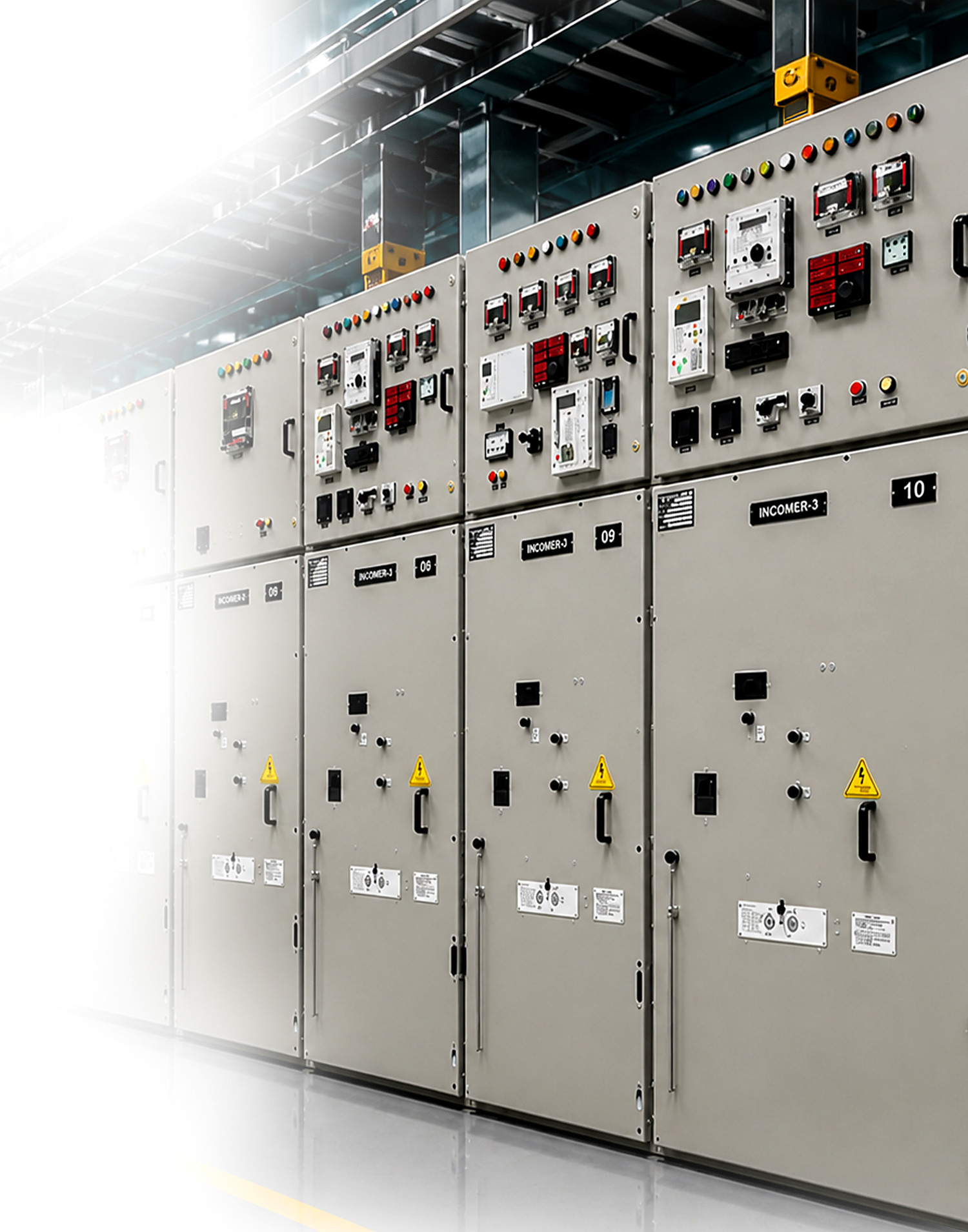
HT and LT panels sit either side of the transformer and are governed by different standards, different construction rules and different failure modes. Confusing their specifications is one of the more expensive mistakes on an electrical package.
The essential difference
| HT panel | LT panel | |
|---|---|---|
| Voltage | 11 kV / 33 kV | 415 V / 230 V |
| Standard | IEC 62271 | IEC 61439 / IS 8623 |
| Switching device | Vacuum circuit breaker, LBS, RMU | ACB, MCCB, MCB, contactors |
| Rated current | 630 A – 2500 A | Up to 4000 A |
| Short circuit | Up to 31.5 kA | Up to 65 kA |
| Sits | Upstream of the transformer | Downstream of the transformer |
| Typical enclosure | IP4X indoor, IP5X outdoor | IP41 to IP54 |
Specifying an HT panel
The vacuum interrupter is the heart of the panel and the one component you should not economise on. We build on Siemens 3AH and 3AF interrupters as an authorised channel partner, which means CPRI type test certificates you can hand to a consultant without an argument.
- Confirm breaking capacity at the actual fault level, not a round number.
- Ask whether the design is type tested as an assembly, or only its components.
- Check compartmentalisation — busbar, cable and breaker should be separated.
- Specify pressure relief. An arc fault has to go somewhere, and it should not be through the front door.
- For revenue metering, insist on Class 0.2S CTs and a DISCOM-approved meter.
Specifying an LT panel
The specification that gets skipped most often is form of separation. Form 1 is an empty box with everything in it. Form 4 fully segregates every functional unit, its terminals and its busbars — which means a fault or a maintenance operation in one feeder does not take out the board.
On any board feeding a hospital, a data hall or a continuous process, specify Form 4. The extra cost is trivial against one unplanned shutdown.
Other things worth writing into the specification: CRCA thickness (2 mm for load-bearing members, not 1.2 mm), electrolytic copper busbars with heat-shrink sleeving, a fully looped earth bus, and cable entry from the direction your cables actually arrive from.
The panel types you will be asked to choose between
- PCC — power control centre, the main incomer board with ACB and metering.
- MCC — motor control centre, with DOL, star-delta or VFD starters per motor.
- APFC — automatic power factor correction, which pays for itself in avoided utility penalties.
- DG synchronising — for paralleling multiple generator sets with AMF and load sharing.
- MLDB and PDB — secondary and final distribution.
A note on buying both from one supplier
The interface between HT panel, transformer and LT panel is where site problems concentrate: CT ratios that do not match the meter, interlocks that were assumed rather than agreed, cable entries on the wrong face. Buying the whole chain from one manufacturer moves that co-ordination off your desk. We build all three in Balanagar.