
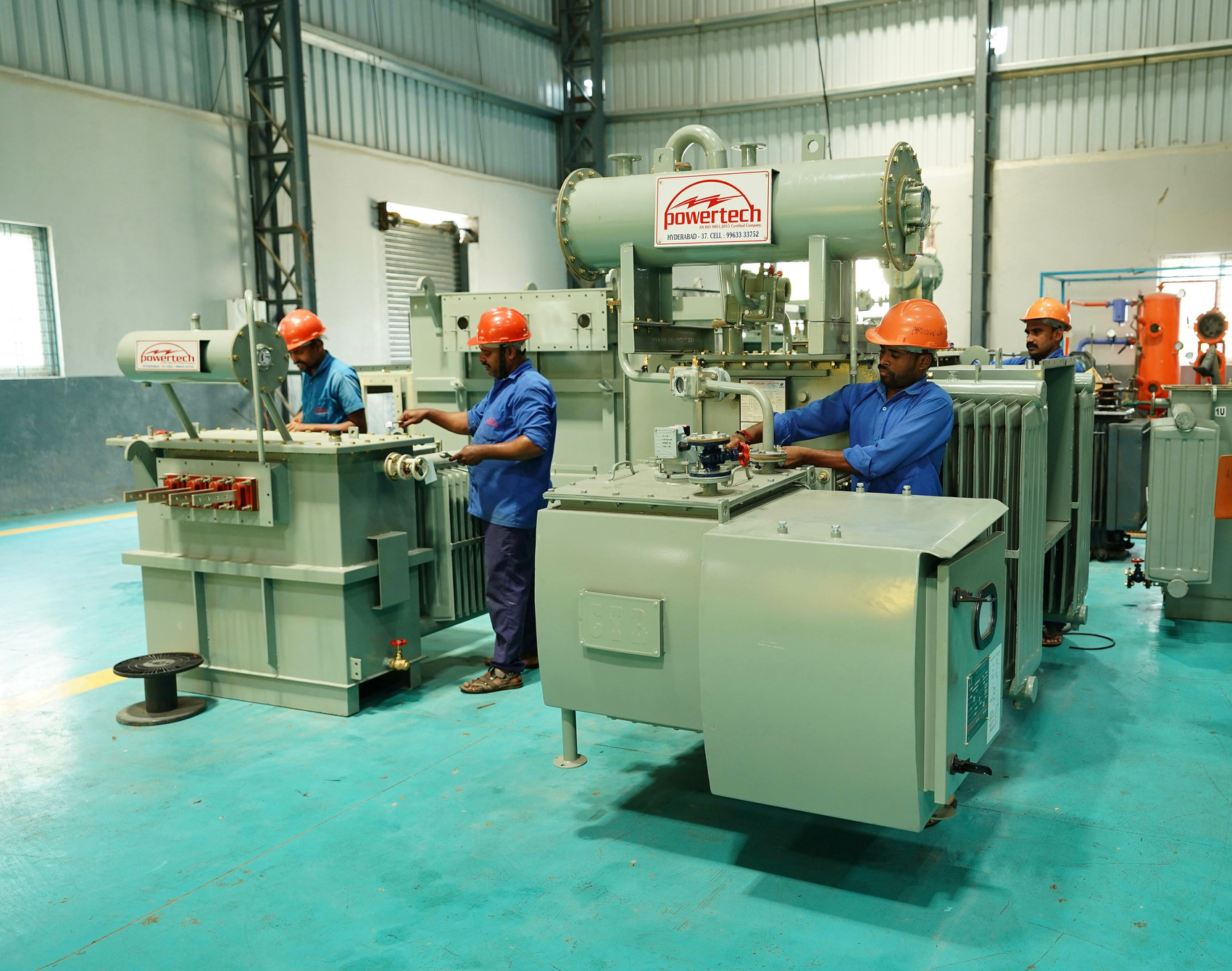
The single most common thing we are asked for is "a 500 kVA transformer". Sometimes that is right. Often the connected load says 500 kVA but the correct unit is 400, and occasionally it is 630. Getting this wrong is expensive in both directions: undersize and the unit runs hot and ages fast, oversize and you pay for copper you never use and sit at a poor efficiency point.
Start with connected load, not demand
Add up every load that can be connected to the transformer, in kW, with its power factor. Convert to kVA by dividing kW by the power factor. If you have a mixed load at an assumed 0.9, a 450 kW connected load is 500 kVA.
This number is the ceiling, not the answer. Almost nothing runs everything at once.
Apply a diversity factor
Diversity is the honest admission that your loads do not all peak together. A factory with three shifts, a hotel with seasonal occupancy and a data centre with N+1 redundancy have very different diversity.
| Building type | Typical diversity | Notes |
|---|---|---|
| Industrial plant, single shift | 0.7 – 0.8 | Process loads are fairly steady |
| Commercial office | 0.6 – 0.7 | HVAC dominates and follows the weather |
| Hospital | 0.7 – 0.85 | Life-safety loads are always live |
| Residential complex | 0.4 – 0.6 | Highly diversified across flats |
| Data centre | 0.85 – 1.0 | Designed to run near capacity |
Multiply your connected kVA by the diversity factor. Our 500 kVA office example becomes about 325 kVA of realistic demand.
Then add headroom, deliberately
Two allowances matter. Future growth — how much more load will this building take in ten years? And loading factor: a transformer is happiest between 50% and 80% of rating. Continuous operation above 80% shortens insulation life.
Taking 325 kVA of demand, allowing 20% growth and targeting 75% loading gives 325 × 1.2 ÷ 0.75 ≈ 520 kVA, so the standard 500 kVA unit is right after all — but now you know why.
Three things that quietly change the answer
Ambient temperature
Standard ratings assume 40°C maximum ambient and 50°C yearly average per IS 2026. A transformer in an enclosed substation room in a Telangana summer sees more. Either derate the unit or ventilate the room properly — and say which you have done in your enquiry.
Harmonic content
Non-linear loads — drives, UPS systems, LED lighting, solar inverters — cause extra heating that a standard unit is not designed for. Above roughly 15% total harmonic distortion you need a K-rated or inverter duty design, not simply a bigger standard one.
Motor starting
A large direct-on-line motor draws six to eight times full load current while starting. If the biggest motor is a significant fraction of the transformer rating, check the voltage dip rather than only the steady-state kVA.
If you send us the connected load schedule, the biggest motor rating and the room details, we will do this calculation with you and put the assumptions in writing.
What to send us
- Connected load in kW with power factor, ideally as a schedule
- Building type and how the load is used across the day
- Largest single motor and its starting method
- Any drives, UPS or solar inverters, with approximate kW
- Where the transformer sits — indoors, outdoors, ventilated or not
- HT supply voltage and whether the DISCOM has fixed a limit
We will come back with a rating, a reason for it, and a proposal. If the honest answer is a smaller unit than you asked for, we will say so.